
Setting the Record Straight on Right to Compute
"That is why we need the Right to Compute Act, to make clear that our fundamental rights must be protected as technology changes."
The following has been adapted from an excerpt of the Frontier Weekly Newsletter written by Tanner Avery for the October 1st edition.
Last week, the Yellowstone County Commission sent a letter to Yellowstone County legislators asking them to rewrite Montana’s Right to Compute Act so local governments can regulate “data centers and similar commercial facilities” without having to meet the Act’s current standard of review.
We sent a letter in response.
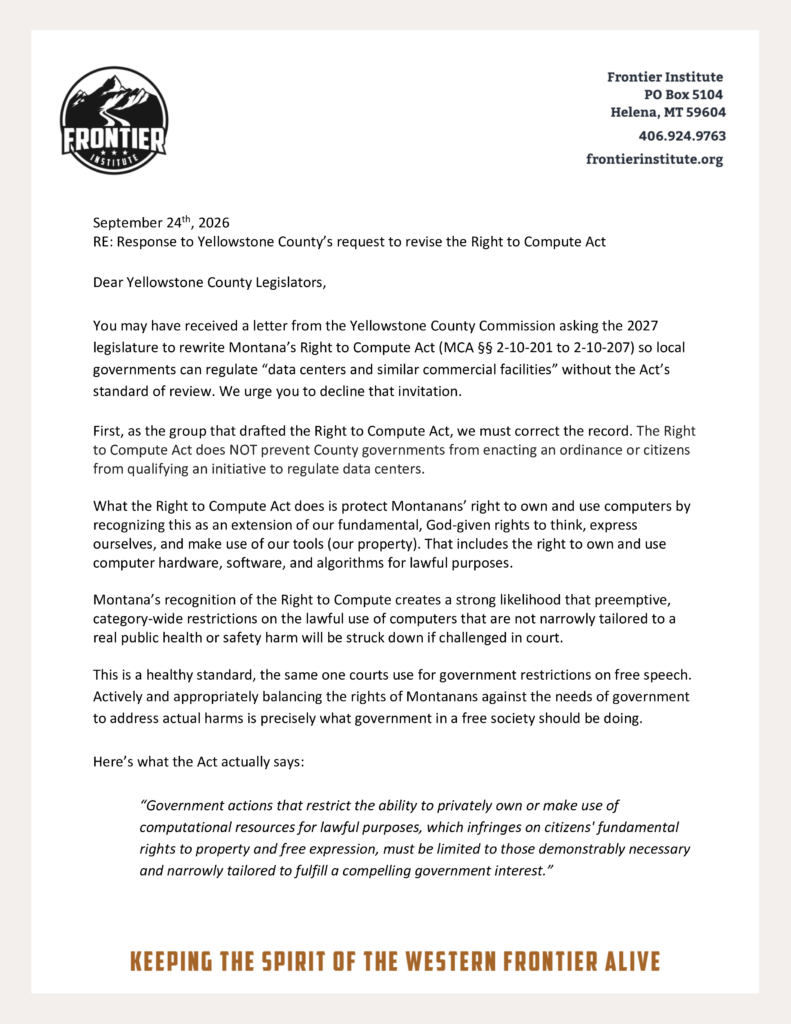
The Right to Compute Act does not bar local governments from regulating data centers. In fact, it explicitly allows government to address real harms, including nuisances created by physical data center infrastructure.
What the law requires is that restrictions on the lawful use of computers be tied to a compelling government interest, narrowly tailored to address an actual harm, and unable to be achieved through less restrictive means.
In plain English: government can regulate the problem, but it should not be able to use the existence of a problem to justify sweeping restrictions that go far beyond it.
We disagree that this standard needs to be weakened. The Right to Compute Act pushes government to actively and appropriately balance the rights of Montanans against the need to address actual harms. That is a healthy standard. It is precisely the kind of balance government in a free society should be expected to strike.
It also forces government to do what they should already be doing: identify the actual harm they are trying to address and craft a regulation aimed at that harm, rather than reaching for overly broad restrictions that limit Montanans’ rights.
Data centers may be the issue putting the Right to Compute Act in the spotlight today, but we drafted it for something much broader.
Computers are the modern-day printing press. They are how Montanans communicate with family and friends, speak publicly, run businesses, manage their money, buy and sell goods, create and share information, access services, and use the technology they own.
Those freedoms can be easy to take for granted because many of these technologies are still relatively new. But as history shows, when new technologies create new concerns, government often responds with powers that reach beyond the original problem. Authority granted today can become the basis for broader restrictions on our freedoms tomorrow.
That is why we need the Right to Compute Act, to make clear that our fundamental rights must be protected as technology changes. As more of our lives move into the digital world, protecting the lawful use of computers increasingly means protecting familiar freedoms in a new setting: the freedom to speak, create, conduct business, use your own property, and make your own decisions without unnecessary government interference.
Technology will change. Protection from government overreach should not.
Yes, government should be able to address real harms. But when it restricts the lawful use of computers, it should have to show why that restriction is necessary and why a narrower approach would not work.